
iPhone Backlight Circuit Repair Explained
- gofixchicago
- 2 days ago
- 5 min read
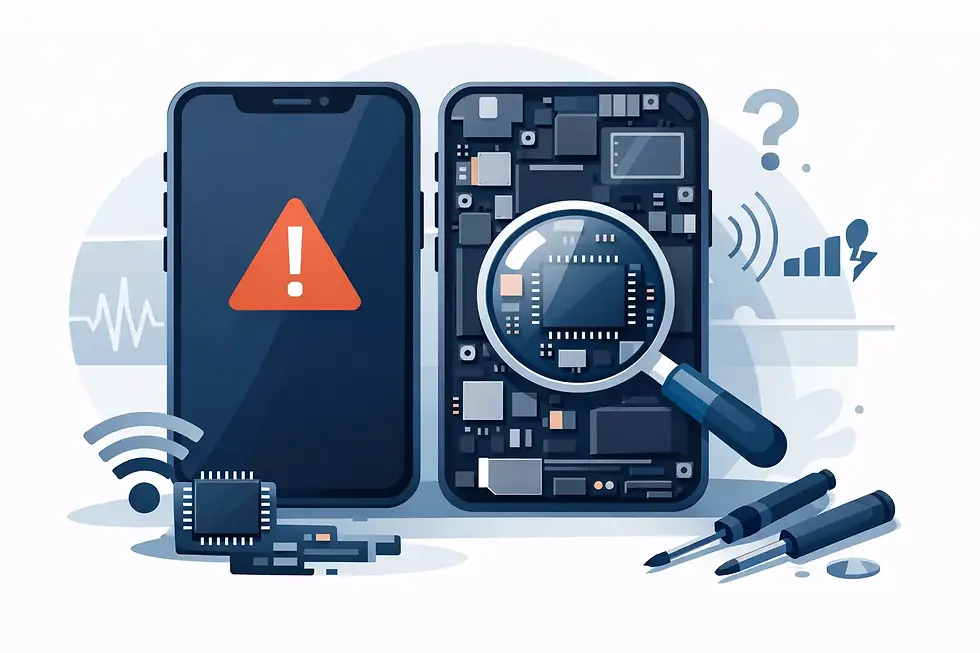
A screen can look completely dead while the iPhone is still receiving calls, vibrating, charging, and producing notification sounds. In many LCD-equipped models, that symptom points to an iPhone backlight circuit repair rather than a simple screen replacement. The display may still be generating an image, but the board is no longer supplying the power required to illuminate it.
That distinction matters. Replacing a screen can resolve a failed LCD panel, torn flex cable, or damaged connector. It cannot restore a burned filter, shorted capacitor, failed boost circuit, or lifted pad on the logic board. When the fault is on the board, the repair requires circuit-level diagnosis under magnification and precision micro-soldering - not another parts swap.
What the iPhone Backlight Circuit Does
LCD iPhones use a dedicated backlight system to illuminate the pixels from behind. The logic board takes battery voltage and steps it up through a boost circuit, delivering controlled power to the backlight lines at the display connector. This circuit is made up of multiple small components working together: a backlight driver, coil, diode, filters, capacitors, resistors, and the traces and pads that carry those signals to the connector.
If one critical component fails, the phone may power on normally but display only a faint image visible under a bright flashlight. In other cases, the screen may briefly light during startup, then go dark as the circuit detects a fault and shuts down.
The circuit applies to LCD-based iPhones, including many older models and newer LCD variants such as the iPhone XR, iPhone 11, and iPhone SE generations. OLED-equipped iPhones do not use a conventional backlight system. Their display failures require a different diagnostic path, which is why identifying the exact model and display technology comes before any board work.
Symptoms That Point to a Board-Level Fault
A dark screen alone does not prove that the backlight circuit has failed. A damaged screen, low-quality replacement panel, disconnected flex cable, or liquid-contaminated connector can produce similar symptoms. The strongest evidence comes from testing the device as a system.
A backlight-related failure is more likely when the phone boots, makes sounds, responds to a charger, or can be detected by a computer, yet the display remains black or extremely dim. A flashlight test can sometimes reveal a faint image behind the dark panel. A known-good screen may also show the same failure, ruling out the original display assembly.
Technicians must also inspect the display FPC connector under digital microscopy. Bent pins, corrosion, missing pads, and damaged solder joints can interrupt the backlight path before power ever reaches the screen. On a device with prior screen repair, connector damage is especially common. A pin can be bent during installation, or a component beside the connector can be knocked off by an improperly placed tool.
Why Backlight Circuits Fail
Backlight damage often begins with a routine event that becomes a board-level problem. Liquid exposure is a major cause. Even a small amount of moisture can corrode connector pins, create leakage around tiny components, or cause a short that overloads the backlight line. The phone may work initially and fail days later as corrosion progresses.
Improper screen replacement is another frequent cause. Disconnecting or reconnecting the display while the battery remains connected can send voltage through lines that are not designed to be handled that way. A slipped tool can also short components near the connector. These failures are small in physical scale but serious electrically.
Impact damage can crack solder joints, damage the display connector, or break microscopic traces inside the board layers. In some cases, a defective replacement screen creates an abnormal load that exposes an already weakened circuit. The timing may make the screen appear responsible, but measurement determines whether the fault is in the panel or on the board.
How Component-Level Diagnosis Works
Proper iPhone backlight circuit repair starts with verification, not soldering. The technician confirms the phone's power state, checks its current behavior, tests with a known-good display, and inspects the connector at high magnification. This prevents a logic board from being altered when the actual problem is a failed screen.
Once a board fault is suspected, the circuit is measured against expected diode-mode readings, resistance values, and voltage behavior. These measurements help identify whether the line is shorted to ground, open due to a blown filter or damaged trace, or missing boost output because the driver circuit is not operating correctly.
Thermal imaging can be valuable when a shorted component is heating under controlled power injection. It can reveal the exact area consuming current without blindly removing parts from the board. Digital microscopy then allows the technician to inspect solder joints, pads, and nearby components with industrial accuracy.
The goal is not to replace every component in the area. It is to isolate the failed section and restore the circuit with the smallest justified repair. That approach protects the board, preserves surrounding circuitry, and produces a result that can be fully tested rather than merely made to light up for a few minutes.
What a Professional Repair May Involve
The physical repair depends on the failure. A damaged filter or diode may be replaced with a matching component. A shorted capacitor may be removed and replaced after confirming it is the source of the short. A failed backlight driver may require controlled hot-air rework, careful pad preparation, and precise alignment of a microscopic integrated circuit.
Connector-related damage can be more demanding. If pads beneath the FPC connector are missing, the technician may need to reconstruct the connection using microscopic jumper wire and secure the repair without affecting adjacent lines. If an internal trace is broken, the route must be identified and rebuilt from a safe alternate point.
This is why generic repair shops often stop at the screen replacement stage. Board-level work requires a microscope, a calibrated soldering station, controlled hot air, reliable schematics or boardview references, and the experience to interpret measurements. The equipment matters, but judgment matters more. A technically possible repair is not always the right repair if corrosion has spread extensively or multiple systems have been compromised.
Repair Versus Replacement: The Real Trade-Off
A backlight circuit fault is often repairable, but the decision should be based on the device condition and the value of its data. A clean, isolated fault on a newer iPhone can be an excellent candidate for component-level restoration. The repair may preserve the original logic board, keep the device functional, and avoid the cost of replacement.
Heavy liquid damage changes the equation. If the board has corrosion in several areas, the backlight issue may be only the first visible symptom. A skilled lab can evaluate the extent of damage, but no responsible technician should promise long-term reliability before the board has been inspected and tested.
Data is another consideration. Unlike a screen replacement, a logic board replacement does not preserve data stored on the original board. For customers with critical photos, authentication apps, business files, or irreplaceable device data, repairing the original board is often the only meaningful path forward.
Why Testing After the Repair Matters
A successful repair is more than seeing the display illuminate once on the bench. The repaired board should be tested with a known-good screen, verified through brightness changes, inspected for stable current draw, and checked for normal startup behavior. The display connector must be secure, and the repaired area should be clean and protected from accidental contact.
When an LCD iPhone is alive but nearly invisible, do not assume the phone is finished or that another screen is the answer. GOFIX approaches these cases as component-level logic board restoration: isolate the electrical fault, repair only what failed, and verify the circuit under real operating conditions. That is the difference between a temporary guess and a repair built to return a critical device to service.


Comments